
Q & A
Frequently asked questions
-
How is the size of a glass wall tent selected?
Glass wall tents are designed with a modular configuration. The appropriate size is primarily determined by the required capacity, site constraints, and the intended use. The following four standard sizes are available. Modular configurations can also be combined or extended to meet specific project requirements:
-
What is the entrance height of the tent?
The entrance heights of Cross Cable Tents and Glass Wall Tents are available in two options: 2.4 meters and 2.8 meters, which can be adjusted based on requirements. However, the taller the poles, the less stable and aesthetically pleasing they become, so it is recommended not to exceed a height of 3 meters.
-
Can a tent canopy be printed with a custom logo?
A tent canopy can be printed with a custom logo using screen printing or cutting sheet sticker methods.
-
What canopy fabric colors are available, and can custom colors be provided?
Twelve stock canopy fabric colors are available for selection. Custom colors beyond the stock options can be provided, subject to a minimum order quantity. Please contact our sales team for details.
-
What is the installation method for the tent? Does it require tools or anchoring?
The tent frame uses a modular, plug-in aluminum pipe system. The pipes can be directly connected during assembly, and in most cases, no drilling or screws are required. The canopy is installed by sliding the Keder bead into the integrated track within the aluminum profiles, allowing for easy positioning and a simplified installation process that improves construction efficiency. The above description applies only to the assembly process. Actual anchoring methods should be determined based on ground conditions. Common anchoring options include ground stakes, expansion bolts, and ballast weights.
-
How long does a tent installation usually take?
Small tent installations can generally be completed within one day (excluding site measurement, transportation, and other preparatory work). The installation time for larger tents depends on whether embedded anchors are required and on the structural configuration. Prior to installation, site planning, ground conditions, and installation methods must be confirmed with the sales team to allow for proper manpower allocation and scheduling. The following are estimated installation times for different tent types:
-
Should the tent be dismantled during a typhoon or severe storm?
Structure Tents and Glass Wall Tents have been wind-tested to withstand up to level 13 winds (moderate typhoon conditions), while smaller tents have been tested to withstand up to level 8 winds (light typhoon conditions). When wind conditions exceed these tested levels, the tent should be dismantled as a precaution. When wind conditions remain below these levels, valuable items inside the tent should be removed in advance and anchoring should be reinforced to ensure safety and protect the tent structure.
-
Can the wall panels, door panels, and windows of a glass wall tent be configured according to individual preferences?
The wall panels, door panels, and windows of a glass wall tent can be freely configured based on individual requirements. Users may select different quantities and placements to suit their specific use purposes.
-
Can lighting be installed inside the tent?
Lighting can be installed inside the tent according to usage requirements. Light fixtures may be mounted on the structural frame or within the interior space without requiring any destructive modification to the tent structure. The tent is compatible with various types of lighting, including LED lights, spotlights, string lights, and pendant lights, allowing suitable lighting solutions to be selected based on specific needs and event atmosphere. Actual lighting configurations should be planned according to tent size, usage scenario, and available power supply.
-
Should the ground be leveled before tent installation?
Yes, proper land grading is essential before installation. Please ensure that the ground surface is leveled and stable before the builder proceeds with the layout. A flat foundation helps prevent structural instability, uneven weight distribution, and potential safety issues. If you need guidance on site preparation, feel free to consult with us for recommendations.
-
Do the tent's doors and windows come with keys that can lock?
Yes, the door comes with a built-in lock, allowing you to secure the space when needed. This ensures basic security and privacy for your tent.
-
Can the tent be moved to another location?
Yes, the tent features a lightweight, modular design that is detachable and easy to reassemble, allowing for quick dismantling and installation at different locations without requiring any destructive modification. This makes it suitable for rental applications that require repeated setup and relocation.
-
How can heat buildup inside a tent be reduced?
Open doors, windows, or side curtains to promote natural ventilation and increase airflow, which helps reduce heat accumulation inside the tent. In addition, cooling solutions such as fans, air conditioning, exhaust systems, or misting systems can be used to improve temperature control. In hot climates, tents with windowed wall panels can enhance airflow, and double-layer canopy fabrics can help reduce excessive heat retention.
-
Can a tent be installed on soil ground?
Yes, the anchoring method for a tent can be selected based on ground conditions. On concrete surfaces, expansion bolts are typically used for anchoring. On soil ground or surfaces without a concrete foundation, ground stakes can be used instead. If staking is not feasible, ballast weights may also be used as an alternative anchoring solution. In addition, raised flooring systems can be used to improve ground leveling and user comfort, serving as a supplementary base option for tent installation. 💡 Flooring Options:
-
How long does it typically take for a tent to be delivered?
Our standard lead time is 45 to 60 days, depending on the order complexity and current production schedule. Since we use premium, high-quality materials, each order is carefully scheduled and produced to ensure superior craftsmanship and durability. To secure your place in our production queue and receive timely delivery, we recommend placing your order as early as possible.
-
Is there after-sales service for the tent?
Yes, ongoing after-sales support is provided. We monitor the tent’s usage conditions and offer appropriate recommendations based on the installation method and operating environment. When typhoons or severe weather are forecast, guidance is also provided based on the customer’s anchoring setup to help with proper storm preparation. Even after the warranty period has ended, assistance and advice are still available whenever tent-related issues arise.
-
What is the warranty period for the tent?
The tent structure and all components are covered by a 1-year warranty (excluding damage caused by human factors). 💡 Need fabric replacement? Over time, tent fabric may become brittle, but it can be replaced separately while the rest of the structure remains fully functional.
-
Will insects get inside the tent?
If doors and windows are left open, insects may enter—just like in any open space. For better protection, we recommend installing fly screen windows, which allow airflow while keeping bugs out.
-
Will the glass in a glass wall tent break?
No. Glass wall tents use 6 mm thick tempered glass that is designed for high durability and impact resistance, capable of withstanding everyday use and environmental stresses. The impact resistance of tempered glass enhances structural safety and long-term reliability, but normal usage practices are still recommended to maintain the safety of the glass and overall structure.
-
Will the aluminum frame corrode in coastal or high-salt environments?
The tent uses an aluminum frame with corrosion-resistant and oxidation-resistant properties, and it can remain durable in humid or coastal environments. However, prolonged exposure to high salt conditions, such as sea breezes at the shore, may accelerate surface aging of the aluminum. Regular cleaning and inspection of the frame are recommended to help extend its service life.
-
How should the tent be cleaned and maintained?
In general, rinse the canopy fabric with clean water to remove dust and debris, preventing buildup over time. For PVC-coated fabrics, a spray-nozzle hose or appropriate cleaning agents may be used for deeper maintenance. After cleaning, ensure the fabric is completely dry before storage to help prevent mold and deterioration.
-
Can the tent be assembled by myself?
Yes. The tent is designed with a modular structure that allows for self-assembly. For first-time buyers, we provide comprehensive installation training and guidance, including a detailed user manual and step-by-step instructional resources to help you complete the setup process with ease.
-
What are the advantages of a modular walkway tent over a traditional covered walkway?
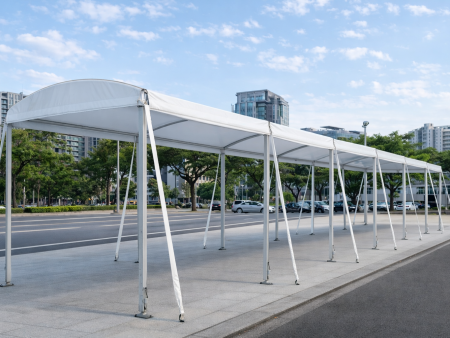
A modular walkway tent offers greater flexibility than a traditional fixed covered walkway. Unlike permanent structures that require extensive construction, a modular walkway system can be installed quickly, expanded as needed and reused at different locations. Each 3 × 3 m module can be connected to create covered pedestrian walkways of various lengths and configurations, making it suitable for both temporary events and long-term outdoor applications. Whether connecting buildings, event tents, entrances or public facilities, the system can be adapted to different site conditions while reducing installation time and overall project costs. Because of its flexibility and reusability, modular walkway tents are widely used in schools, hotels, resorts, exhibition venues, public infrastructure projects and outdoor events.
-
Can a modular walkway tent be configured with corners or intersections?
Yes. A modular walkway tent can be designed with a variety of layouts to accommodate different site requirements and pedestrian traffic patterns. Depending on the project, the walkway can be configured as a straight passage, L-shaped walkway, T-shaped intersection or other customized layouts. Multiple modules can also be combined to connect buildings, event areas, entrances, parking facilities and public spaces.